Pitch deck
Sales Deck for Small Business: What to Send Before a Big Meeting
They'll look at what you send on their phone, between other things, the night before. Here's how to make a deck that works there, slide by slide.

Contents
The short answer
A small business sales deck should open with the buyer's problem, show what it costs them to do nothing, explain your fix in plain words, prove it with something real, and end with one clear next step. Keep it to about ten slides, tailor it to the meeting, and make sure it opens properly on a phone.
The meeting's next Thursday. It matters.
They've asked you to "send something over beforehand".
So you open PowerPoint, find an old template, and start typing everything you've ever done. Thirty slides later it's 1am, and it still doesn't feel right.
Here's what actually happens to that file. They open it on their phone. Between other things. Maybe the night before. They swipe through the first two slides, squint at tiny text, and decide.
I'm Thomas. I run my own businesses with Harris, an AI operator built on Claude Code (the plain guide is Claude Code for business owners). I've built our own scroll-through deck, and I make decks for other businesses as a job. Here's how to make one that works where it's really read.
What is a sales deck, and do I need one?
A sales deck is a short set of slides made to win a customer. It's different from an investor pitch deck, which is made to win funding. Most small businesses need the first, even if everyone calls it a pitch deck.
You need one when:
- Someone asks you to "send something over".
- The job is big enough that more than one person decides.
- You'll be compared with someone else.
What should a sales deck include, slide by slide?
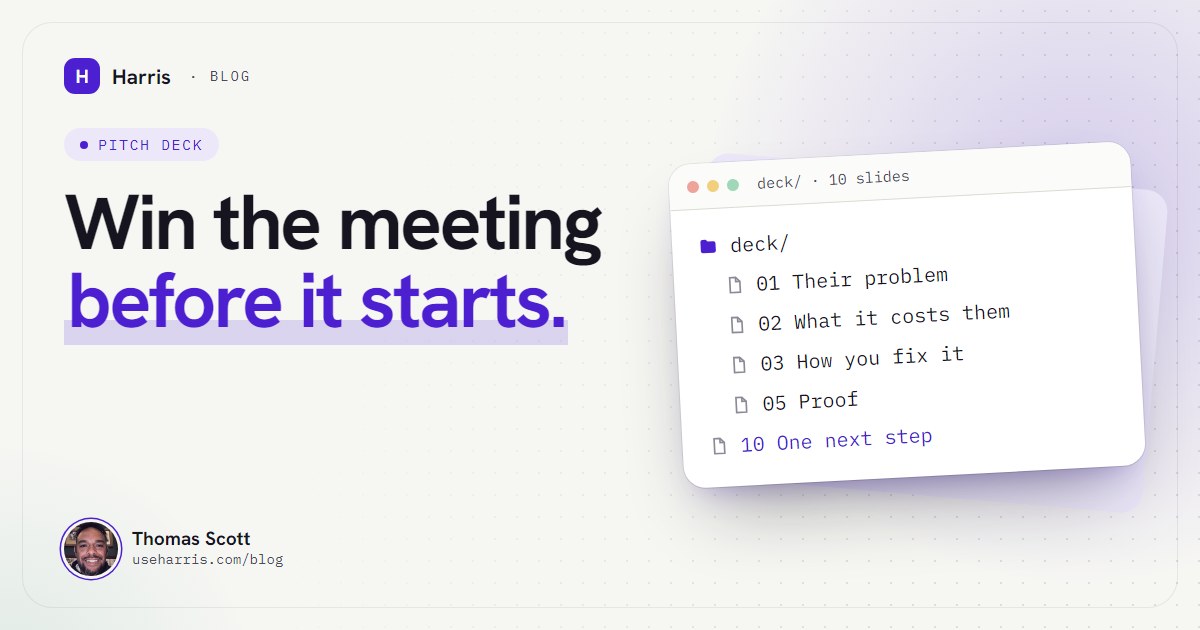
Build it as a story about them, not you. Here's a running order that works for most small business meetings:
- Their problem. In their words. If they nod at slide one, you're in.
- What it costs them to do nothing. Time, money, stress, missed work. Be specific to them.
- How you fix it. Plain words. No jargon. One slide.
- How it works. Three steps, what they do and what you do.
- Proof. A real job, a real photo, a real result you can stand behind. Smaller, similar businesses beat big famous names.
- What's included. So there are no surprises.
- The price, or how pricing works.
- Questions they'll have. Answer the obvious worries before they ask.
- Who you are. Short. Why you, not why your company.
- One next step. What happens if they say yes, and by when.
That's ten. If you've got more, put it in an appendix. First Round Review, published by a venture firm that backs start-ups, says your core presentation shouldn't spend time on anything unnecessary, and that the deck should follow your sales story, step by step.
How do I make a deck people actually read?
Write for the phone first. Then it will work everywhere.
- One idea per slide. If you need a second idea, you need a second slide.
- Big words, few of them. If you have to zoom in on a phone, it's too small.
- Your strongest point on slide one or two. That may be all they see.
- Tailor it. Their name, their problem, their numbers. First Round's advice is to use specific, tailored customer information, so they can see what you'd do for them.
- Don't wait for perfect. A clear, plain deck sent on time beats a beautiful one sent late.
What should I leave out?
- Your company history. One line on who you are is enough. Put it near the end.
- Every service you offer. Only the one that fixes their problem.
- Jargon. If they'd need to look a word up, use a plainer one.
- A thank-you slide. End on the next step instead.
TipBefore you send it, open it on your own phone. Swipe through in thirty seconds. If you can't follow your own story that fast, neither can they.
Should I send a PDF or a web deck?
Both, if you can.
A PDF is safe. It opens anywhere and it can be forwarded to the person who actually signs off.
A web deck is a link. People scroll it like a web page, and it can move: things appear as you scroll, a short film can play. It feels less like homework.
Here's the first screen of ours. You can open the whole deck and scroll it on your phone.

If the meeting is about launching something, a lookbook can sit beside the deck: see merch mockups. And if you're not sure what to pitch yet, start with where AI would save you the most time.
What does Harris charge for a pitch deck?
The pitch deck job is from £1,495. One-off. No monthly fee.
What you get:
- A scroll-through web deck.
- A phone-friendly PDF.
- One round of changes.
What I need from you: your logo, your numbers and what the meeting is for.
What happens next:
- You press Buy now on the listing and pay securely with Stripe.
- You get an email asking for the few things I need.
- I deliver by email, usually within 72 hours of getting them.
- You can book a free set-up call with me if you want one.
The proof: our own scroll-through deck and the landing page every Harris buyer starts from. Both live. Open the deck and judge it yourself.
Got a meeting this week? Book a free call and tell me the date.
Questions people ask
What is the difference between a sales deck and a pitch deck?
A sales deck is made to win a customer. A pitch deck is usually made to win an investor. Small businesses mostly need the first, even if people call it a pitch deck.
How many slides should a sales deck have?
About ten is plenty for most small business meetings. One idea per slide. Anything extra can go in an appendix at the end.
Should I send my deck before the meeting?
Often, yes, especially if they asked for it. Send something that opens on a phone, and keep your strongest point on the first two slides, because that may be all they read.
What should the last slide say?
One clear next step, with a date if you can. Not a thank-you slide. Tell them exactly what happens if they say yes.