Claude vs ChatGPT
Claude vs ChatGPT for Small Business: Which One Can Run It?
Most comparisons score the writing. That stopped being the question a while ago. The useful one is which tool can actually run part of your business, and the answer is closer than the fans on either side admit.

Contents
- Is Claude or ChatGPT better for a small business?
- Claude vs ChatGPT at a glance
- Which AI remembers your business better?
- Can either one work on the files on your PC?
- Which one can run automations while you're away?
- Which is cheaper for a small business?
- The verdict for each kind of owner
- Can you use Claude and ChatGPT together?
The short answer
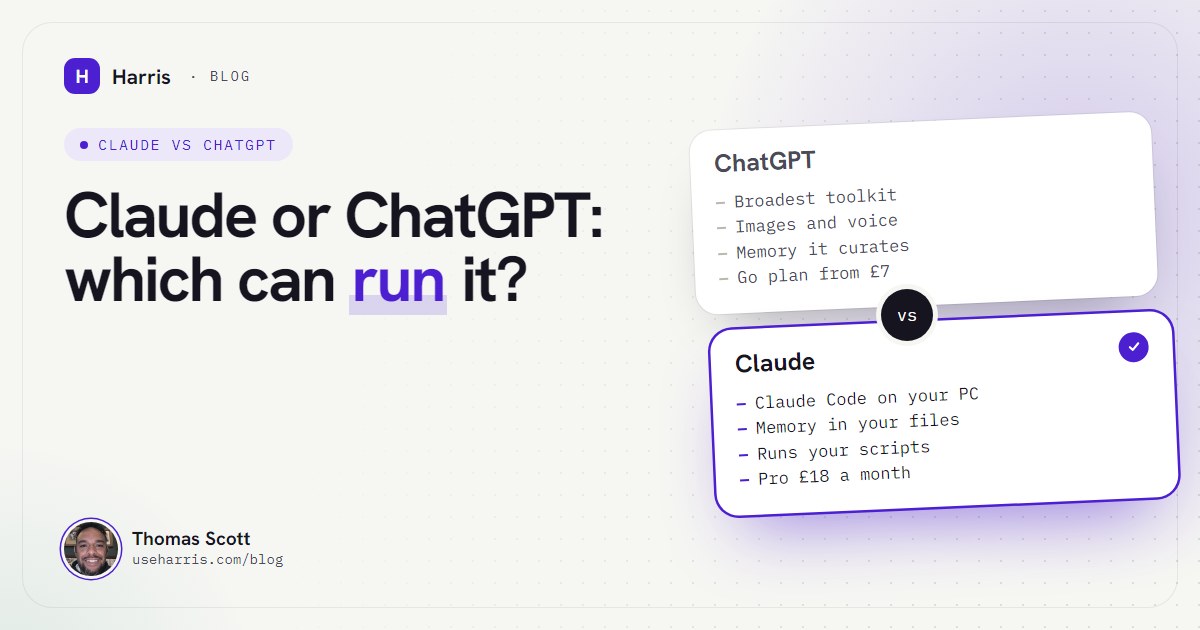
Both now offer agents, memory, scheduled tasks and Windows apps, at about £20 a month for the main paid plan. ChatGPT has the broader toolkit, with image creation and voice on every plan. Claude, through Claude Code, is stronger when you want an AI that keeps your business in files you own and runs work on your PC.
You've used both. ChatGPT is the one everyone in your WhatsApp group talks about; Claude is the one a friend swears by for writing. You've read the comparisons, and they score which one writes the nicer email. That isn't your problem. Your problem is that you're running a business with not enough hours in the day, and you want to know which of these can take some of it off you.
I'm Thomas Scott. Since 16 August 2026 I've run four small businesses from one Windows PC with Harris, an AI operator built on Claude Code and a vault of plain notes. So I have a side, and I'll tell you where it is. But I also think ChatGPT is the better tool for a lot of owners, and I'll say exactly when.
If Claude Code is new to you, my guide to Claude Code for business owners explains what it is. This post compares the two products you'd actually pay for.
Is Claude or ChatGPT better for a small business?
Neither, as a blanket answer, because both have changed shape this year. At the time of writing (October 2026), each now has three layers:
- Chat: the conversation you know.
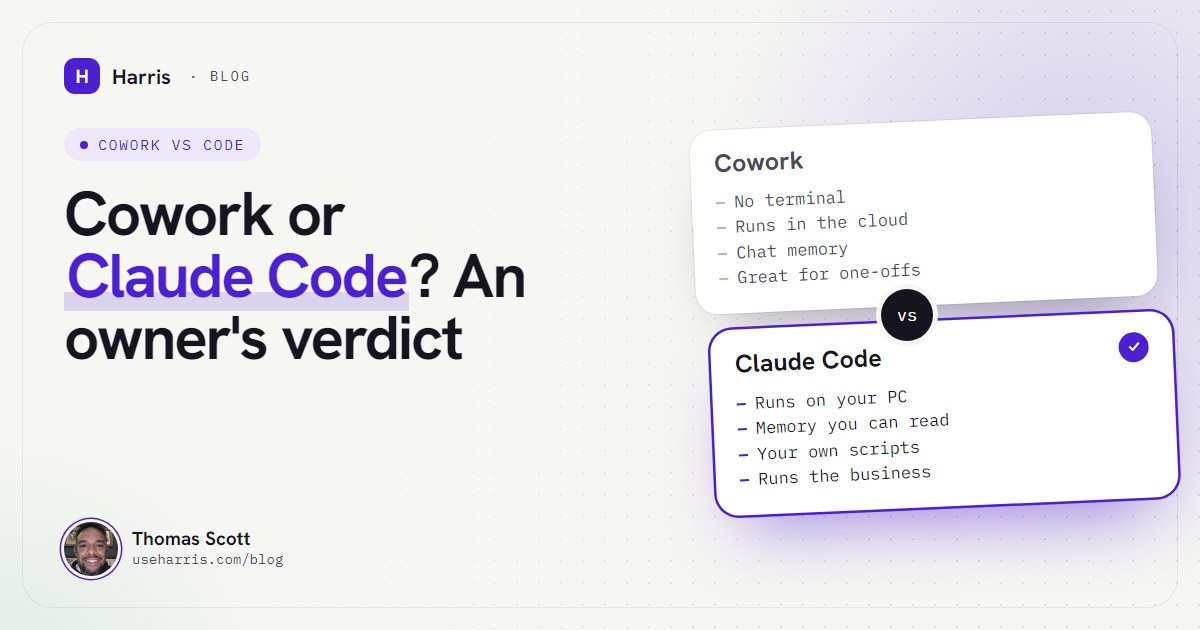
- An agent for longer jobs: OpenAI calls it ChatGPT Work. Anthropic called it Cowork, and is now folding it into the main Claude app. You describe an outcome, it works through the steps and hands back a finished document, spreadsheet or report.
- A coding agent that can also run your computer: OpenAI's Codex and Anthropic's Claude Code. Both are built for software, and both will happily do non-software work on your files.
So "which is better?" splits into better questions. Which one remembers your business? Which can work on the files on your PC? Which can run things on a schedule? Which runs properly on Windows? And what does each cost once you use it properly?
Claude vs ChatGPT at a glance
Every product fact here was checked on OpenAI's and Anthropic's own pages at the time of writing (October 2026). UK prices are those shown to a UK account, and Anthropic's include 20% VAT.
| ChatGPT | Claude | |
|---|---|---|
| Cheapest paid plan (UK) | Go, £7 a month (may include ads) | Pro, £18 a month (£15 billed annually) |
| Main paid plan (UK) | Plus, £20 a month | Pro, £18 a month |
| Heavy-use plan | Pro from £89 a month ($100, $200 or $500 tiers) | Max from £90 a month ($100); Ultra $200 (as of November 2026) |
| Team plan | Business, £18 a seat a month (£15 annually) | Team, Standard and Premium seats |
| Memory | Saved memories plus past chats, automatic | Chat memory automatic; Claude Code reads files you write |
| Agent for long tasks | ChatGPT Work | Cowork, now part of the Claude app |
| Work on files on your PC | Work in the desktop app, with permission; Codex | Cowork via the desktop app; Claude Code directly |
| Scheduled tasks | Go, Plus and Pro | All paid plans (Cowork); Claude Code in three ways |
| Windows desktop app | Yes | Yes |
Two things stand out. They're priced almost identically where most owners will buy. And the gap that used to separate them, which one can actually act, has mostly closed. What's left is a difference in philosophy about memory and about where the work runs.
Which AI remembers your business better?
This is the question I care most about, because the cost of an assistant that forgets is that you become its memory.
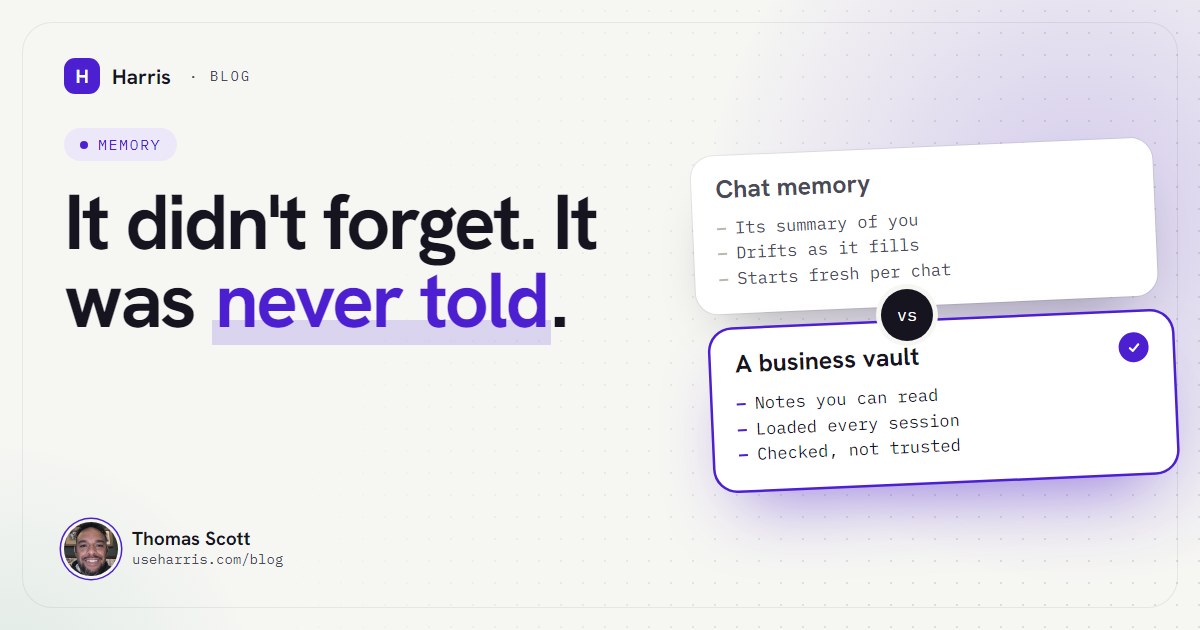
ChatGPT's memory is automatic. OpenAI's memory help page describes it drawing on saved memories, past chats, custom instructions, files and connected apps such as Gmail. You can see a summary, correct it, and check which sources shaped an answer. It's well designed and it asks nothing of you. OpenAI is also candid about its limits: it says memory does not retain every detail from every conversation, and ChatGPT decides what's relevant.
Claude's chat memory works in a similar spirit, and it's on every plan, including free. But Claude Code takes a different approach, and it's the one I built on. Instead of a memory the AI curates, you give it files. A CLAUDE.md file in the folder it starts from holds your rules and instructions, and it reads that at the start of every session, every time. Mine tells Harris who it is, what it must never do, and to read the vault index, yesterday's daily note and my priorities list before saying a word.
ChatGPT: memory it curates
- Builds itself as you chat, no setup
- Pulls from past chats, files and connected email
- You see a summary and can correct it
- Decides for itself what's worth keeping
Claude Code: memory you own
- Plain files you write and it reads every session
- Holds clients, priorities, decisions and rules
- Open it in any editor, back it up, version it
- Takes an afternoon to set up properly
The difference shows when something goes wrong. When Harris gets something wrong, I can find the line in the vault that caused it and fix it, and the fix sticks. Every rule in my boot file exists because of a failure: never claim something is done without checking it, never overwrite a note another session might be writing, never paste a long prompt into the Windows terminal because it truncates silently. A curated memory can't hold rules like that with the same certainty.
If "it forgot everything again" is why you're reading this, why Claude and ChatGPT forget everything goes into the mechanics.
Can either one work on the files on your PC?
Yes, both can now, and this is where the old comparisons are most out of date.
ChatGPT. OpenAI's Work and Codex article says Work on web and mobile runs in the cloud, while Work in the desktop app can use local files and desktop apps with your permission. It also notes that messages and task context may be stored in the cloud even when the work runs locally. Codex, a separate view in the same desktop app, works with local folders, terminals and developer tools. The desktop app runs on Windows and macOS.
Claude. Cowork reaches folders you connect while the Claude desktop app is open; since 6 October 2026 its tasks on Pro and Max run in Anthropic's cloud and fetch copies of what they need (Anthropic's Cowork guide has the detail). Claude Code is the other way round: it runs on your PC, inside a folder, and works on files and tools directly.
For a Windows owner, both are workable. The practical difference is how far each will go into your machine. Claude Code runs whatever you've installed (PowerShell, Python, your own scripts) with the permission prompts you set. That's how Harris runs my local console, my voice and my scheduled scripts. Codex can do much of the same, and in fairness Harris itself can run on Codex as well as Claude Code. But ChatGPT's main path for an owner is Work, which is built around finished deliverables rather than running your machine.
One honest warning about either: an agent on your own PC is not a sandbox. It acts with your Windows permissions. Run it on an account only you use.
Which one can run automations while you're away?
Both have scheduled tasks now.
ChatGPT includes scheduled tasks on Go, Plus and Pro. OpenAI recommends cloud runs for scheduled research and website checks because your computer doesn't need to be awake. For steps that need your files or tools, the laptop has to stay online.
Claude has scheduled tasks in Cowork on every paid plan, and they run in the cloud, though a task needing local files only runs locally. Claude Code adds three more ways: loops inside a session, desktop tasks that use local files while the PC is on, and cloud routines that run with the PC off but without your local files.
The pattern is the same on both sides: cloud for anything living in your online tools, your own PC for anything touching your own files and scripts. Where I've ended up is Claude Code writing plain scripts and Windows Task Scheduler running them, so the critical jobs fire even when no AI session is open. On 12 October I handed Harris a written spec at half past one, and at four o'clock the first post went out on schedule by itself. By the next lunchtime, 12 clips across three channels had 2,331 views.
Which is cheaper for a small business?
At the entry paid tier, it's a draw: ChatGPT Plus at £20 a month on a UK account, Claude Pro at £18 (or £15 a month billed annually) on Claude's pricing page. ChatGPT has the cheaper first step: Go at £7 a month, with the caveat that it may include ads, and Free covers a surprising amount.
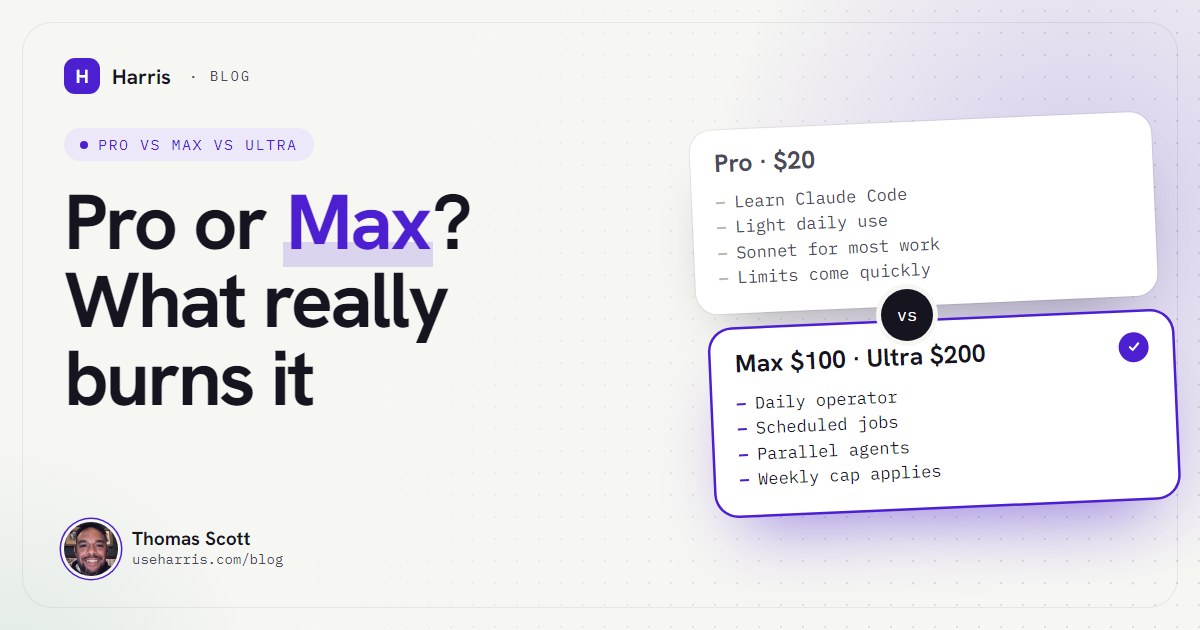
The real cost shows up when you use the agents properly. Both companies meter agent work more heavily than chat. Anthropic says multi-step Cowork tasks use more of your allowance than a quick question, and Claude's chat, Cowork and Claude Code all share one allowance. OpenAI says Work follows the same usage structure as Codex and that longer tasks use more. If an agent is doing hours of work for you every day, expect to move to Claude Max (from £90) or ChatGPT Pro (from £89). I ran Harris on Claude's top plan, then called Max 20x (now Ultra, $200 a month as of November 2026), and in early October my setup still hit the weekly limit. The detail is in Claude Pro vs Max vs Ultra for business owners.
For a team, ChatGPT Business is £18 a seat a month (£15 annually) on a UK account, with no training on business data by default. Claude's Team plan has Standard and Premium seats. Price them for your headcount, not mine.
The verdict for each kind of owner
You want one AI for everything, mostly on your phone. ChatGPT Plus. Image creation and voice on every plan, a broad set of features, and a memory that builds itself. Fairly hard to go wrong.
You're on a tight budget and want to start today. ChatGPT Go or Free. Claude's free plan is good for chat, but Claude Code and Cowork need a paid plan.
You write a lot and want the strongest drafting partner. Try both on your own real writing for a week. Plenty of owners prefer Claude's writing, and plenty don't. A table won't settle this one.
You want an AI that knows your whole business and does the recurring work on your own PC. Claude, with Claude Code. Memory in files you own, rules that stop repeat mistakes, and scripts that run your jobs. Setup is the price, and it's an afternoon, not a project.
You're on a Mac. Either works for you. Harris itself is Windows-only for now, so this post's last recommendation doesn't apply to you yet.
You run two to five ventures and keep losing the thread. This is the case I built Harris for. Choosing between Cowork and Claude Code is the next decision, and Claude Cowork vs Claude Code covers it.
Can you use Claude and ChatGPT together?
Yes, and I'd encourage it. These aren't marriages. The useful split for most owners: ChatGPT for quick questions on the move, voice and images; Claude Code as the operator that holds the business memory and runs the recurring work. The memory lives in your own files, so nothing is lost if you change your mind about either company next year.
The one thing I wouldn't do is spread your business's memory across both. Pick one place where the truth about your clients, priorities and decisions lives, and make everything else read from it. That single decision matters more than which logo is on the app.
Questions people ask
Is Claude or ChatGPT better for small business owners?
ChatGPT has the broader feature set, with image creation and voice on every plan. For an AI that works on your own computer with a memory of the business you can read and edit, Claude with Claude Code is stronger. Most owners will get value from either at the entry paid tier.
Which AI remembers your business better, Claude or ChatGPT?
ChatGPT's memory is more automatic: it saves details and references past chats without you doing anything, though OpenAI says it doesn't keep every detail. Claude Code remembers through files you write and it reads every session, which takes setting up but means you can see and correct exactly what it knows.
Can I use Claude and ChatGPT together?
Yes, and plenty of owners do. A common split is ChatGPT for quick questions, images and voice on the phone, and Claude Code as the operator that holds the business memory and runs the recurring work.
Which is cheaper for a small business?
At the time of writing (October 2026), ChatGPT has the cheapest paid tier, Go at £7 a month on a UK account. At the main paid tier they're close: ChatGPT Plus is £20 and Claude Pro is £18 a month in the UK. Heavy agent use pushes both towards their £89 to £90 plans.