Email newsletter
Email Newsletter for Small Business: What to Send, How Often, and the UK Rules
Your past customers have forgotten your name. Not because they didn't like you. Because nobody reminded them. Here's a newsletter routine a busy owner can actually keep.

Contents
- Why does a small business need an email newsletter?
- Can I email my customers? The UK rules in plain English
- How often should a small business send a newsletter?
- What should I put in a business newsletter?
- What is a welcome email sequence?
- What does our own newsletter look like?
- What does Harris charge to email your list?
The short answer
A small business newsletter works best when it's short, regular and useful. Send one helpful thing and one clear next step, on a pace you can keep, weekly or fortnightly for most. In the UK, only email people who agreed or who bought from you, and give an easy way to unsubscribe in every email.
You've got a list. Maybe it's a spreadsheet of past customers. Maybe it's the sign-up box on your website that nobody's emailed in a year.
Those people liked you enough to buy, or to give you their email. Then you went quiet.
So when they need what you sell again, they search for it. And they find someone else.
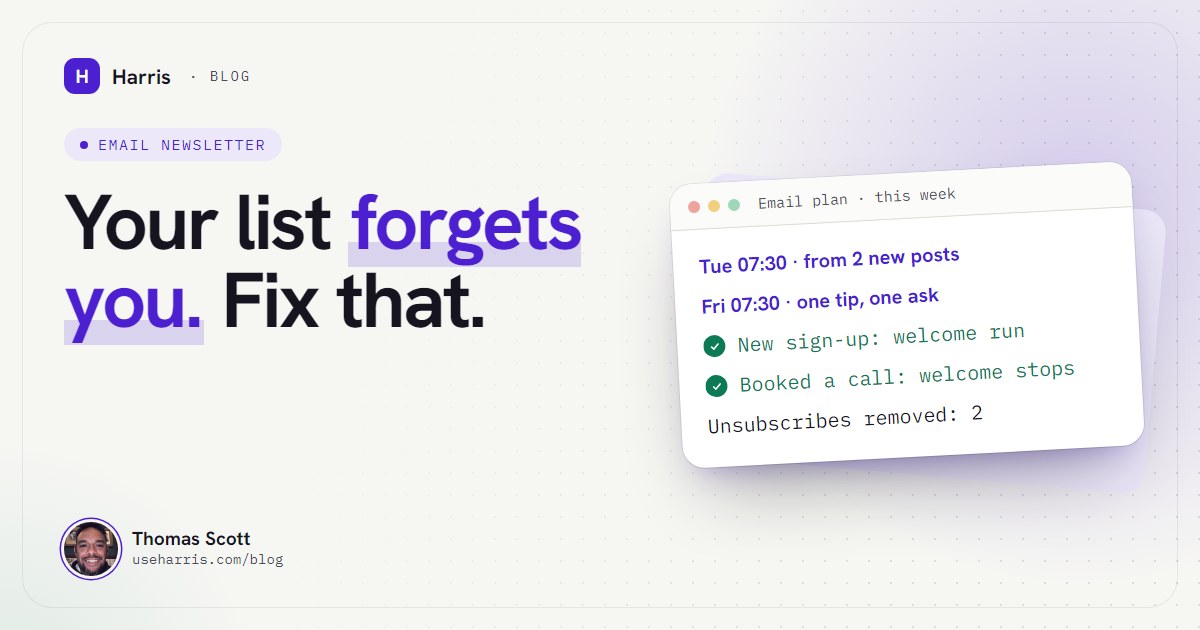
They didn't stop liking you. They forgot you. A newsletter is the cheapest fix there is.
I'm Thomas. I run my own businesses with Harris, an AI operator built on Claude Code (the plain guide is Claude Code for business owners). Our own email has gone out twice a week since 20 October. Here's how to run one, even if you hate writing.
Why does a small business need an email newsletter?
Because you own an email list. You don't own your followers.
Instagram can change what it shows. An account can get locked. But an email address someone gave you is yours to write to, for as long as they want to hear from you.
Think of the list as a bank account. Every useful email is a deposit. Every "buy now" is a withdrawal. Send only offers and the account empties: people unsubscribe. Mostly give, sometimes ask.
Can I email my customers? The UK rules in plain English
This is the bit people get wrong, so let's start here.
The rules for marketing emails to individuals are in regulation 22 of the UK's PECR. In short:
- You need their consent, unless the "soft opt-in" applies.
- The soft opt-in covers people whose email you got while selling to them, as long as you only market similar things, and you gave them a simple way to opt out when you collected the email and in every email after.
- A bought list is out. Those people never agreed to hear from you.
And make leaving easy. Google's guidance for senders says to always give recipients an easy way to unsubscribe, and big senders must offer one-click unsubscribe.
Watch outThis is a plain summary, not legal advice. If you're unsure about a particular list, check before you send.
How often should a small business send a newsletter?
Pick a pace you can keep for a year, not a week.
For most small businesses, that's weekly or fortnightly. We send twice a week, but we have a system doing the work. If it's you writing by hand, start fortnightly and do it every time.
A newsletter that arrives every other Tuesday builds trust. One that arrives three times in January and never again doesn't.
What should I put in a business newsletter?
Keep it short. One email, one job. Here's a shape that works:
- A subject line that earns the open. Helpful or curious beats "Newsletter, issue 4". Try "The one question every new client asks me".
- One useful thing. A tip, a mistake to avoid, a before-and-after. Something they'd thank you for.
- A little news. A new service, a date you're booked up to, a price change.
- One clear next step. Book, reply, or have a look. Just one.
You don't need new ideas every week. Reuse what you already made. That post you put on Instagram, or that answer you gave a customer, rewritten as a short email, is a newsletter.
What is a welcome email sequence?
It's a short run of emails that go out on their own when someone new signs up. It's the most useful email you'll ever set up, because it catches people when they're most interested.
A simple version:
- Email 1, straight away: thanks, here's what you asked for, here's who I am.
- Email 2, two days later: your best piece of help.
- Email 3, a few days after: one clear offer or a link to book.
The key detail: stop the run once they've booked. Nobody wants "have you thought about booking?" the day after they booked.
What does our own newsletter look like?
Here's our Tuesday email, as it landed in an inbox on 5 November 2026. It was written from our new posts and sent automatically at 07:30.
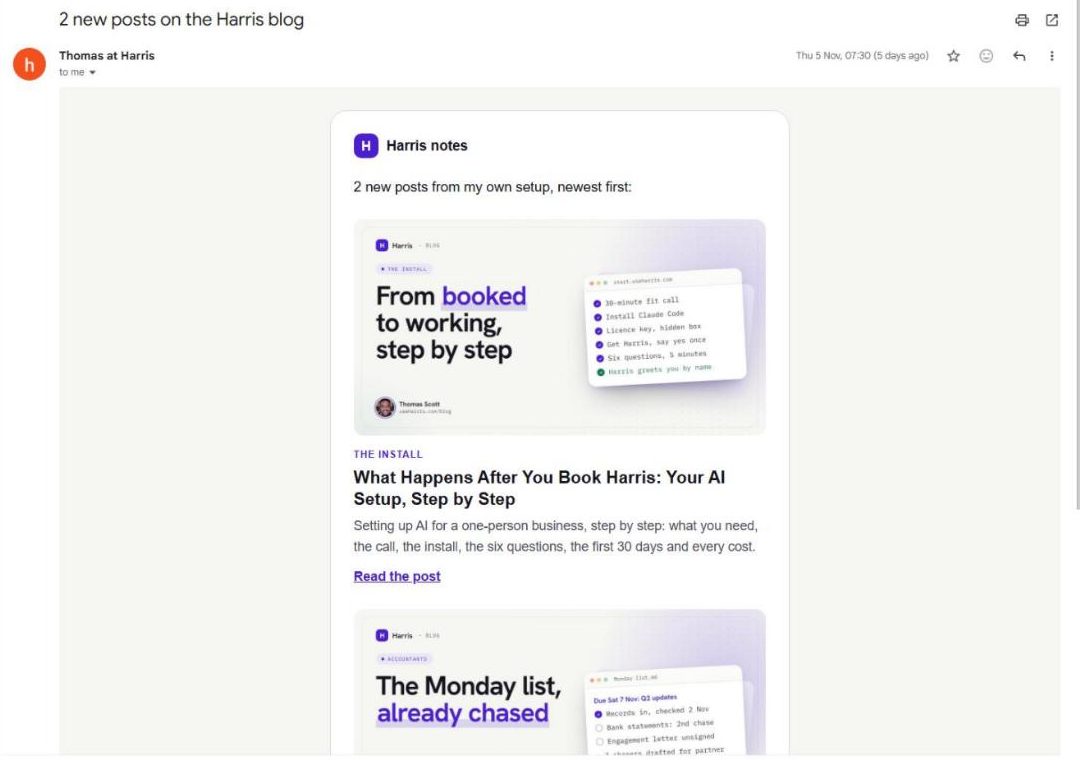
Nothing clever. A picture, a line about each post, a link. That's enough to be remembered.
Need people to sign up in the first place? Comments are a good source: comment-to-DM automation gets your link to anyone who asks. And short videos give you something to send: see short-form video for small business.
What does Harris charge to email your list?
The Email my list job is from £995, then from £195 a month. Any monthly fee only starts once it's live and you've said yes.
What you get:
- A short email twice a week, made from what you've posted.
- A welcome run that stops when someone books.
- Unsubscribe handled.
What I need from you: your list, or the form where people sign up.
What happens next:
- You press Buy now on the listing and pay securely with Stripe.
- You get an email asking for the few things I need.
- I set it up, usually within 72 hours of getting them.
- You can book a free set-up call with me if you want one.
The proof: our own twice-weekly email has gone out since 20 October. You can read what it sends, because it's made from these posts.
Not sure your list is ready? Book a free call and I'll tell you.
Questions people ask
How often should a small business send a newsletter?
As often as you can keep it useful. For most small businesses that's weekly or fortnightly. A steady rhythm matters more than the exact day, so pick a pace you'll still keep in March.
What should I put in a business newsletter?
One useful thing your customers care about, a short bit of news, and one clear next step. Reuse what you already posted on social media or your blog, rewritten for email.
Can I email my past customers in the UK?
Usually yes, under the soft opt-in, if you got their email when they bought from you, you only market similar things, and you gave them a way to opt out then and in every email. Otherwise you need their consent.
What is a welcome email sequence?
A few emails that go out automatically when someone joins your list. They introduce you, give them your best help, and ask for one action, then stop once they've taken it.