AI consulting
AI Consultant for Small Business (UK): Where AI Would Save You the Most Time
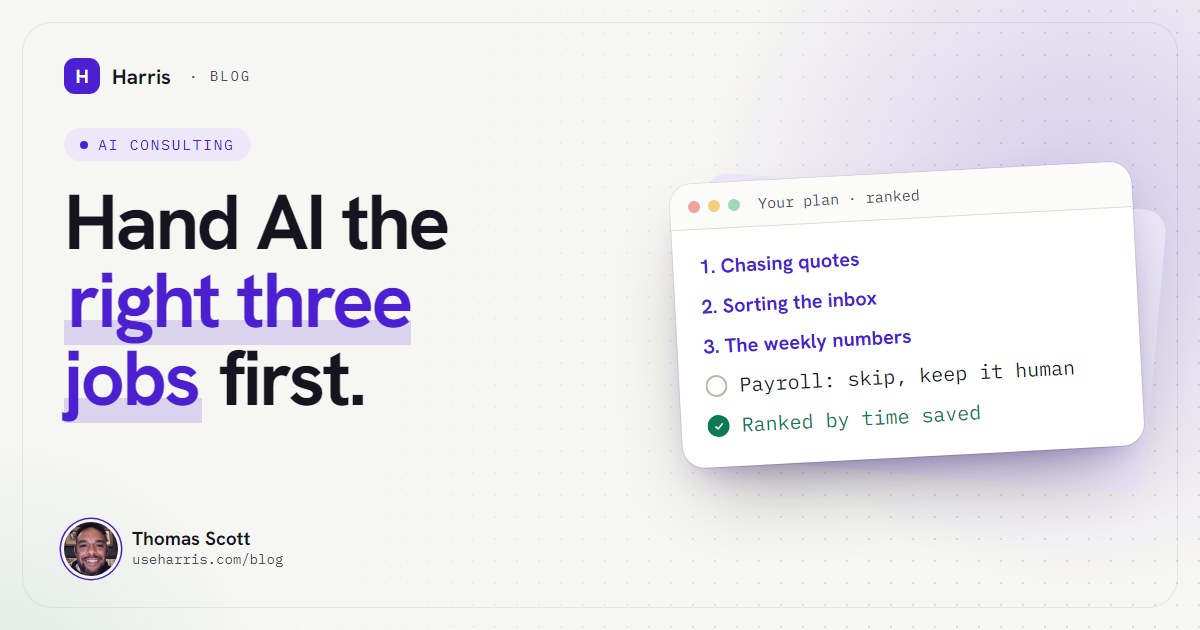
Most owners don't need more AI tools. They need to know which three jobs to hand over first, and which to leave alone. Here's how to work that out, with or without help.

Contents
The short answer
A good AI consultant for a small business starts with your week, not with tools. They find where your hours go, rank the jobs AI could take by time saved and risk, and give you a short plan: the first three jobs, what each costs, and what to skip. You can try a simple version yourself.
You know AI could help. Everyone keeps telling you.
You've tried ChatGPT. It wrote a decent email once. But you can't see how it turns into actual hours back in your week.
So it sits there. Another thing you should get round to.
You're not alone. The UK government's own AI Adoption Survey 2026 found a third of UK businesses (32%) were using at least one AI technology. Among businesses not using AI, 65% pointed to the lack of a clear business case, or proven return.
That's the real problem. Not the tools. Knowing which job to hand over first.
I'm Thomas. I run my own businesses on AI every day, with Harris, an AI operator built on Claude Code (the plain guide is Claude Code for business owners). Here's how to work out where AI would save you the most time, yourself. Then what a good AI consultant adds.
Where should a small business start with AI?
Start with your week, not with a tool.
Tools change every month. Your week doesn't. The jobs you repeat every Monday, every time a quote goes out, every time someone pays late: those are where the hours are.
AI is good at jobs that are:
- Repeated. The same kind of task, many times a week.
- Rule-shaped. You could explain the steps to a new starter.
- Safe to draft. If the first go is wrong, you catch it before it reaches a customer.
AI is bad at jobs where one mistake hurts someone and nobody checks.
How do I find the jobs AI should take first?
Run this one-week test. It costs nothing.
- Log your week. Every time you do a task that isn't your actual trade or craft, jot it down with roughly how long it took. Quotes, emails, chasing, posting, bookkeeping.
- Group the repeats. By Friday you'll see the same five or six jobs eating your time.
- Score each one. Hours a week. How rule-shaped it is (1 to 3). How bad a wrong draft would be (1 to 3, where 3 is bad).
- Pick the top three. Most hours, most rule-shaped, least harm if wrong.
- Test the top one for two weeks. Use a free AI chat tool to draft it. You check and send. Time yourself.
- Decide. If it saved real time, keep it and look at the next one. If not, drop it. That's a result too.
TipWrite your business down once, in a single note your AI reads at the start of every chat: what you sell, your prices, your rules. It stops you re-explaining yourself every time, and the drafts get better straight away.
If you'd like the prompts for that weekly look, the £15 Weekly Review Kit does it in thirty minutes a Monday. And the £29 AI Operator File is that one-note setup, step by step.
Which jobs do small businesses usually hand to AI first?
Every business is different, which is why the log matters. But the same few jobs come up again and again in small firms:
- Following up quotes. The polite "did you get a chance to look?" message nobody enjoys writing.
- Sorting the inbox. What needs you today, what can wait, what's junk.
- First drafts of replies. Prices, availability, "can you do it cheaper?". You check, then send.
- The weekly numbers. Paste in your week and get a plain summary of what moved.
- Answering when you can't. Missed calls and comments are often the biggest leak of all. See an AI receptionist for missed calls and comment-to-DM automation.
Notice what's not on the list: anything where a wrong answer goes straight to a customer, the taxman or a bank with nobody checking.
What does a good AI consultant actually do?
The same thing as the test above, faster, with someone who's done it before.
A good one:
- Asks about your week before naming any tool. If the first thing they say is a software name, be careful.
- Runs AI in their own business. Advice from someone who's lived with it beats advice from slides.
- Tells you what to skip. Including "you don't need AI for this".
- Gives you something written. A plan you can act on without them.
To see what AI looks like running real jobs once you've picked them, read twelve automations I run in my own businesses.
What does the Harris AI consulting session include?
The session is £3,000 an hour. You book a time straight after you pay.
What you get:
- A one-hour working session on a video call.
- A written plan: the first three jobs to hand off, ranked.
- What each would cost, and what to skip.
- The recording to keep.
What I need from you: an hour, and an honest look at your week.
What happens next:
- You press Buy now on the listing and pay securely with Stripe.
- You book a time straight after you pay.
- We do the session on a video call.
- You get the written plan and the recording.
The proof: I run my own businesses on AI every day.
The honest bit: if the answer is "you don't need AI for this", that's what the plan will say.
After the session, some owners want the whole system set up for them. That's the full Harris install, and you can see what happens after you book it. If you just want to talk first, book a free call.
Questions people ask
How much does an AI consultant cost in the UK?
It varies widely, from day rates to fixed projects, so compare what you get for the money. Ours is a one-hour working session for £3,000, with a written plan and the recording to keep.
Where should a small business start with AI?
With a list of the jobs you repeat every week and how long each takes. Pick the one that takes the most time, follows the same steps each time, and does little harm if a draft is wrong. Start there.
Do I need an AI consultant?
Not always. If you can spend a week logging your time and two weeks testing one job, you can do the first step yourself. A consultant is worth it when your time is worth more than that, or you've tried and stalled.
What should I ask an AI consultant before hiring them?
Ask what questions they'll ask about your business, and whether they run AI in their own. A good one talks about your week before they name a single tool, and tells you when you don't need AI at all.