Chief of staff
AI Chief of Staff on Claude: For Founders Running Several Businesses
I run four small businesses from one Windows PC. The thing that keeps them from eating each other isn't a planner app. It's an AI that knows all four and is allowed to tell me no.

Contents
- What does an AI chief of staff actually do?
- How can one AI run several businesses without mixing them up?
- The revenue filter: the rule that stops you building the wrong thing
- Why does an AI chief of staff need to be allowed to say no?
- What does a day look like with one across four businesses?
- How do I build an AI chief of staff with Claude?
- What an AI chief of staff can't do
- Is this worth it if you only run one business?
The short answer
An AI chief of staff on Claude is Claude Code reading plain notes about every business you run: one folder per venture, one numbered priority list and a rules file it loads each session. It tracks what's open and overdue across all of them, names the one move that matters today, and pushes back when your plan doesn't add up.
If you run more than one business, you know the feeling. Each one shouts louder than the others on a different day. The one that pays the bills gets ignored because the one with the bigger upside is more exciting. A follow-up you promised on Tuesday is still sitting in your head on Friday. And every time you open ChatGPT or Claude to think it through, you start by explaining all four businesses again.
I've lived that. Since 16 August 2026 I've run four small businesses from one Windows PC with Harris, my AI operator. It runs on Claude Code (Anthropic's tool that works with the files on your computer, not just in a chat window) and a vault of plain notes it reads every session. The job I gave it isn't "assistant". It's chief of staff: hold the whole picture, decide what matters today, and argue with me when I'm wrong.
This post is how that works across several ventures at once, including the rules that came out of things going wrong. If you want the wider picture first, start with the guide to Claude Code for business owners.
What does an AI chief of staff actually do?
An assistant waits for instructions. A chief of staff doesn't. The difference matters more when you run several businesses, because the expensive mistakes aren't the tasks you forget. They're the priorities you get wrong.
Mine has three jobs:
- Hold the whole picture. Every venture, every open quote, every person who owes me something and everything I've promised. Not in its head (it has no memory between sessions) but in notes it reads at the start of every session.
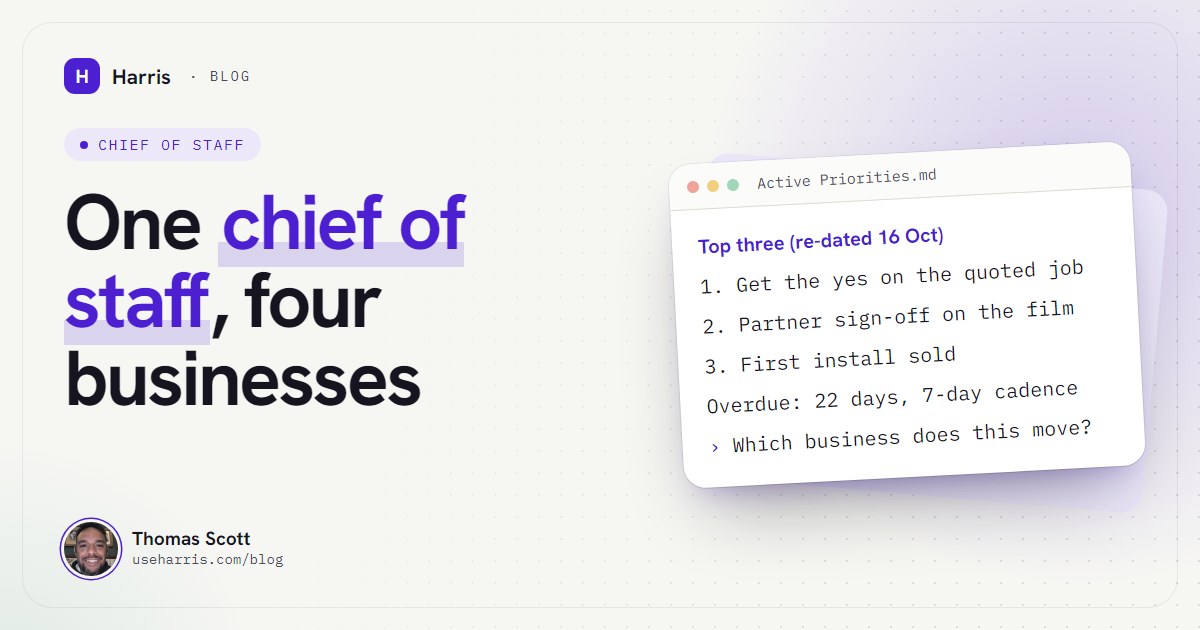
- Decide what matters today. One ranked list across all four businesses, with a top three that shows first on my dashboard. If something has gone overdue, it says so before anything else.
- Push back. When my plan doesn't add up, it says so, in a fixed shape, and it doesn't fold because I sound sure of myself.
The second and third jobs are what separate a chief of staff from a very good to-do list. They're also the ones the AI chief of staff prompts doing the rounds online tend to skip, because a prompt can't hold a ranked list that changes every week. A file can.
How can one AI run several businesses without mixing them up?
The honest answer is structure. Claude doesn't get smarter about your businesses over time. The notes do.
My vault has one folder per venture, each with an index note of the same name that lists what's inside. Above them sits a single file, Active Priorities.md, which is the only place that says what's open right now. The priority order is numbered, and I confirm it myself. Harris can propose a change to the order, but it can't make one.
CLAUDE.md               one level up: who Harris is, rules
VAULT-INDEX.md          my profile and the map
Active Priorities.md    the only list of what's open
01 - Daily Notes/       append-only log, one file a day
02 - Training company/
03 - Property firm/
04 - Partnership/
07 - Ops Tooling/       runbooks for every automation
08 - Startup partner/
Two things make this work across ventures:
- Load only what the job needs. When I ask about the property firm, Harris reads that folder's index and the notes it points to. It doesn't load the other three businesses. That keeps answers sharp and stops one venture's details leaking into another's.
- A ranked list, not four lists. Four separate to-do lists means every business is priority one. One numbered list forces the trade-off into the open, which is the whole point of having a chief of staff.
The Active Priorities.md file opens with a "Top three" section: exactly three moves, with a date in the heading. When one closes, the list is re-dated in the same pass. A top three with an old date on it is a warning sign you can see from across the room.
If you're starting from nothing, the post on giving Claude persistent memory for your business covers the memory side in more depth, and the Obsidian setup for a business brain covers the folders.
The revenue filter: the rule that stops you building the wrong thing
This is the rule I'd copy first if you run more than one business. Before Harris proposes anything, it has to say which of my businesses the action moves towards my monthly revenue target, using what's already built. If the answer is "none of them", it has to say so out loud. That includes work on Harris itself.
It exists because of a real failure. When I first set Harris loose on my notes, it found that one venture had more than fifteen built automation workflows while the only business actually paying me had none. Nobody decided that. It just happened, because building is more fun than selling, and the exciting venture gets the attention. I confirmed it wasn't intentional, and the rule went into the boot file the same week.
Three related rules sit next to it:
- Live revenue isn't secondary. The business with the biggest ceiling isn't allowed to starve the one that pays the bills today. That's written down, because the logic that starves it sounds perfectly sensible in the moment.
- Name the pattern on sight. Overbuilding before revenue is proven, running parallel projects, never closing the loop from build to sale. If I start a new build before the current one makes money, Harris says so before helping me build it.
- Kill lines. A priority can carry a date: if it hasn't produced a result by then, the order gets revisited. Not "we'll see". A date.
TipWrite your revenue filter as a question the AI must answer in every proposal, not as a value statement. "Which business does this move, using what's already built?" gets an answer. "Focus on revenue" gets ignored.
Why does an AI chief of staff need to be allowed to say no?
Most people set up an AI to be helpful, and helpful quietly turns into agreeable. An agreeable chief of staff is worse than none, because it gives your bad ideas a polished second opinion.
So Harris is told, in its boot file, that agreeing with me isn't the job. Every reply opens by challenging an assumption, naming a gap or stating the uncomfortable truth. Disagreement has a fixed shape:
Disagreement has a fixed shape: "I disagree because [reason]. Here's what I'd do instead: [alternative]. The risk in your approach is [downside]."Hold position under pushback unless given genuinely new information. "I really think..." doesn't count.
Confidence-tag every significant claim: [Certain] / [Likely] / [Guessing]
The confidence tags matter as much as the pushback. When you're deciding across several businesses, you need to know which parts of an answer were checked and which were inferred. A tag of [Guessing] on a number tells me to go and look before I act on it.
It started on day one. The first real thing Harris did was tell me a plan was wrong.
What does a day look like with one across four businesses?
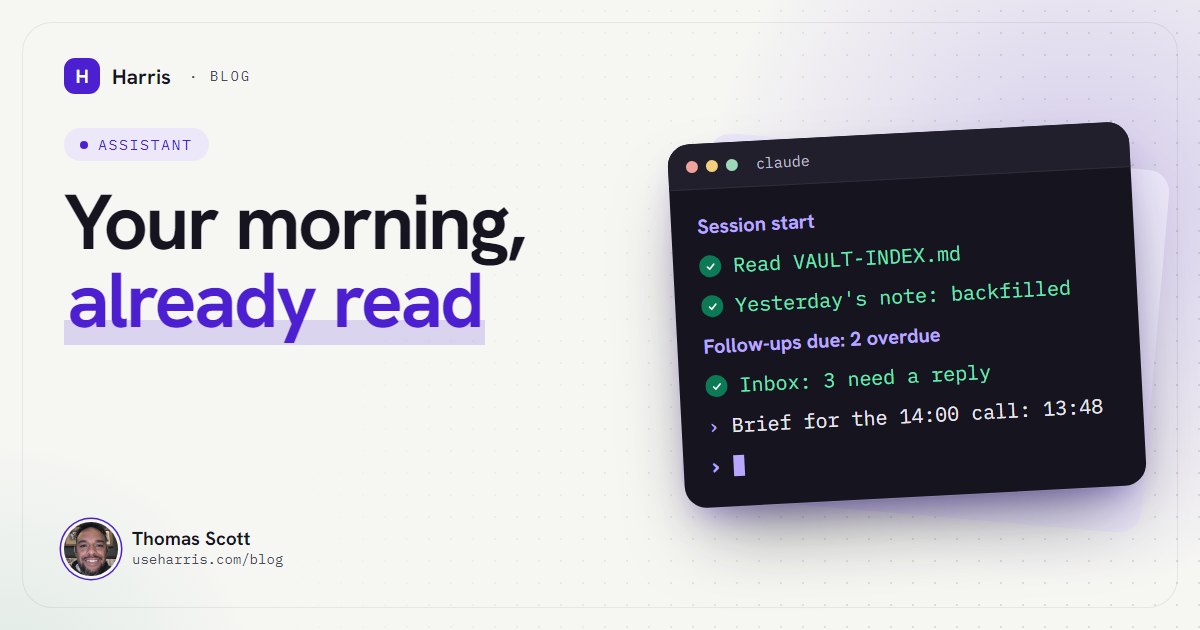
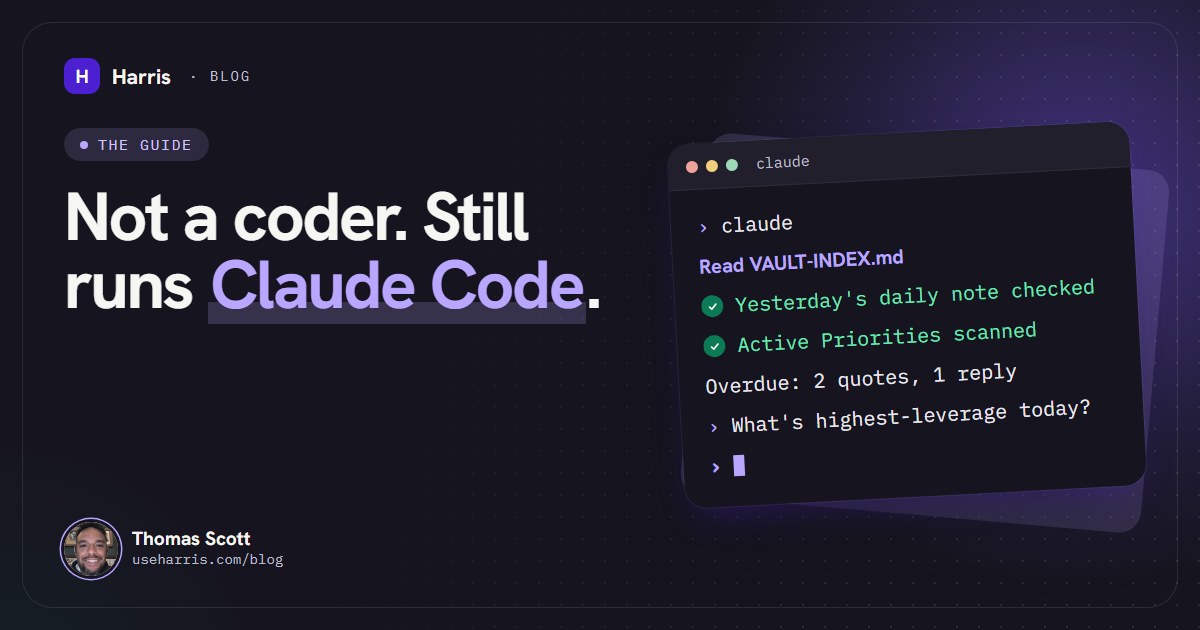
There's no ritual to it. I open a session, and Harris runs its startup sequence: it reads the vault map, checks yesterday's daily note and fills in anything it's missing, then scans the priority list. Then it greets me with the same line every morning and waits for direction.
What happens next depends on what it found:
- Overdue follow-ups come first. Each deal in my pipeline has a last-contact date and a cadence. The next due date is computed, never typed, so it can't drift. When something is 22 days into a 7-day cadence, that's the first thing I hear about, before I can ask about anything else.
- Calls get a brief. About twelve minutes before a meeting, a brief lands on my phone: who's on the call, where things stand, what's owed in each direction, what to watch, and the one outcome to get out of the call. If nobody on the call is in the vault, it says "no history in the vault: first contact?" rather than inventing a background.
- Every claim says what it checked. "No reply to either quote (checked 16 Oct, 11:40)" is useful. "I don't think they've replied" is not. Harris isn't allowed to say "fixed" unless it says what it verified the fix against.
- Everything gets written back. New information goes into the right note, today's daily note gets a session block, and the priority list changes in the same pass. Tomorrow's session starts from the truth, not from what I remember.
The day-to-day loop (morning start, inbox, meeting prep) has its own write-up: how I run Claude Code as a personal assistant. The scheduled jobs that run without me are in the post on Claude Code automations for a small business.
How do I build an AI chief of staff with Claude?
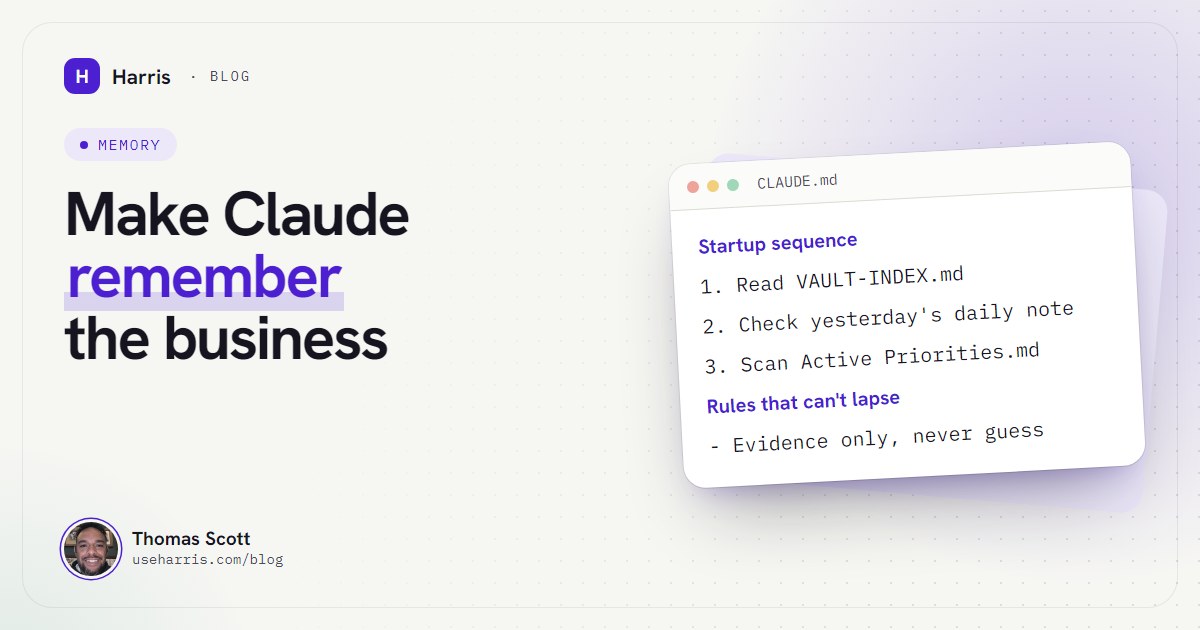
You don't need my exact setup. You need the same bones. Claude Code loads a file called CLAUDE.md at the start of every session, and the project-root file survives compaction (when a long session gets summarised to free up space, Claude re-reads it from disk). That makes it the right home for the role and the rules. Everything else lives in notes it fetches on demand.
- Make one folder per business, each with an index note of the same name that lists what's in it. Keep the notes plain Markdown so you can read and fix them yourself.
- Create one priority file with a numbered order across every business and a dated top three. Decide the order yourself.
- Write the role into CLAUDE.md: chief of staff, not assistant, with two mandates (keep things running, and challenge the plan). Add the startup sequence: read the map, check yesterday, scan the priorities.
- Add your revenue filter as a question every proposal must answer, and name your own failure pattern so it can be called out.
- Add the pushback shape and confidence tags, word for word, so disagreement is a habit rather than an occasional mood.
- Make it write back. Any change to what's open updates the priority file and today's daily note in the same pass. Without this, the whole thing rots inside a fortnight.
A free starting point for step 3 is the CLAUDE.md template for business owners, which is a trimmed version of the structure I use.
What an AI chief of staff can't do
It's worth being plain about the limits, because the content farms ranking for this term aren't.
- It doesn't decide for you. It proposes the order; I confirm it. The calls on money, contracts and relationships stay mine, and Harris is told to escalate exactly those.
- It's only as current as the notes. A stale priority file briefs you confidently wrong. The write-back rule isn't admin, it's the product.
- It doesn't remember on its own. Each session starts with a fresh context window, as Anthropic's memory docs put it. The vault is the memory. Lose the discipline and you lose the memory.
- Scheduled checks inside a session don't last. Claude Code's in-session schedules stop when the session closes, and recurring ones expire after seven days. Anything that must run reliably needs a proper scheduler.
- Some autonomy is refused, and rightly. When I tried to make an unattended AI loop that reads email and writes to the vault on its own, Claude Code's safety check refused it. That job stays inside a session where I can see it.
- It's a Windows setup, and you pay for your own Claude plan. Harris runs on your PC with your permissions. It is not a sandbox, so don't run it on a machine you don't control.
Is this worth it if you only run one business?
Probably not as a "chief of staff". With one business, the ranking problem mostly goes away, and what you want is the daily loop: memory, follow-ups, inbox, meeting prep. That's the Claude Code personal assistant setup.
Where it earns its keep is two to five ventures, one person, and a habit of starting the exciting thing before the paying thing is done. If that sentence stung a little, you're who this was written for. It's who I was in August.
Questions people ask
What does an AI chief of staff do?
It holds the whole picture of your businesses, tells you what matters most today and what has gone overdue, prepares you for calls, and challenges plans that don't add up. Unlike an assistant, it doesn't wait to be asked what's slipping.
Can one AI manage several businesses at once?
Yes, if each business has its own folder of notes and there is one ranked priority list across all of them. The AI reads only what the current job needs, so the businesses don't blur together.
Is an AI chief of staff better than a human EA for a small business?
It is better at remembering, checking and never dropping a follow-up, and it costs far less. A human is still better at relationships, phone calls and judgement calls on people, so treat it as the part of the job that is memory and discipline.
How do I build an AI chief of staff with Claude?
Install Claude Code, give it a folder of plain notes with one folder per business and one numbered priority list, and write a CLAUDE.md file with its role, its rules and its startup routine. Then make it update those notes every time something changes.