Speed to lead
Speed to Lead: How to Call Every Enquiry Back in Seconds
The enquiry that comes in while you're up a ladder is the one you lose. Here's why the first few minutes matter, what you can do about it yourself, and how Harris rings every enquiry back in seconds.

Contents
The short answer
Speed to lead is the time between someone asking you for a call and you actually ringing them. For a trade or a small firm, it often decides who the customer talks to first. Harris rings each enquiry back within seconds, says it's an AI, books a time in your diary, texts a link, and only rings people who asked.
You know the one.
You're up a ladder, or under a sink, or halfway through a rewire. The phone goes in your pocket. You can't get to it.
Or someone fills in the form on your website: "Can you ring me about a leak?" You see it at teatime. You ring back, and they say, "Sorry, I've already got someone booked."
That's the whole problem. Nobody told them no. They just didn't wait.
I'm Thomas. I'm in construction, and I run my businesses with Harris, an AI business partner I built for people like me. (If you want the nuts and bolts, it runs on Claude Code, and I've written up how Claude Code works for business owners.) This post is about one job Harris now does: ringing every enquiry back in seconds. People call this speed to lead.
What is speed to lead?
Speed to lead is how long it takes you to get back to someone who asked to hear from you.
The clock starts when they ask. A form sent. An email saying "give me a ring". A tick in the "call me" box.
It stops when they hear your voice. Not when you see the message. When you actually ring.
For most one-person firms and small trades, that gap is hours. Not because you don't care. Because you're working.
Why does a slow call back lose the job?
Because the person who asked is still looking.
They want a roofer, a plumber, a cleaner or a physio, and they want one now. So they don't ask one firm. They ask a few, and they talk to whoever gets back first.
The research on this comes from sales teams, mostly in the US, not roofers in Wakefield. I'm not going to pretend otherwise. But it points the same way every time.
- The minutes matter. The Lead Response Management study, run with Professor James Oldroyd of MIT on more than 15,000 leads, found a 21-fold drop in the odds of qualifying a lead when the first reply slipped from 5 minutes to 30. Between 5 and 10 minutes, the odds fell fourfold.
- Almost nobody is fast. Workato, a software company, filled in demo requests at 114 companies and timed the replies. Only 31% phoned at all. The average phone reply took 14 hours and 29 minutes. None phoned within five minutes. (Workato sells a tool that routes leads, so it has a reason to find this. The numbers are still what they measured.)
- It's been known for years. Harvard Business Review ran Oldroyd's research back in 2011 under the title The Short Life of Online Sales Leads. The finding then: most companies are not responding nearly fast enough.
So the honest version is this. Nobody can promise you more jobs from ringing faster. But a slow call back hands the customer to whoever was quicker, and right now, almost everyone is slow.
How quickly should you respond to an enquiry?
As fast as you can, and ideally in minutes. If they asked for a call, they're thinking about the job right now. In three hours, they're thinking about whoever rang them.
You can get a long way on your own. Here's what I'd do before paying anyone a penny.
- Measure it for one week. Write down when each enquiry came in and when you rang back. Most owners are shocked by the gap.
- Ask for permission on your form. Add a tick box: "Yes, ring me about this", next to a mobile field. You get the number, and you know they want the call.
- Make two call-back windows a day. First tea break and lunch, say. Not the end of the day, when they've already rung round.
- Text first if you can't ring. "Sorry, I'm on a roof. I'll ring you at twelve." Ten seconds, and they know you're real. Then ring at twelve.
- Hand the first call to someone else. Someone in the office, an answering service, or an automatic call back. Anything that isn't you up a ladder.
The catch with all of these is that they still depend on you, or on someone you pay to sit by a phone. Step 5 is where Harris comes in.
How does Harris call leads back in seconds?
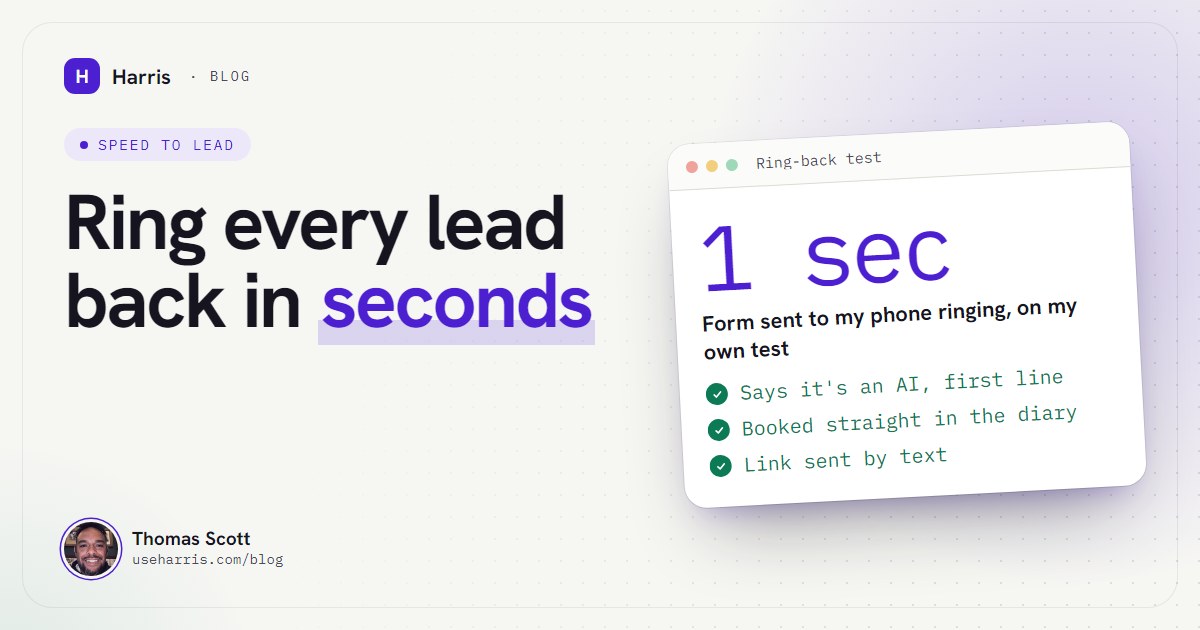
I tested this on myself first. I ticked the box on the form on my own website and pressed send. My phone rang one second later. Harris booked the call and texted me the links, like I was a customer.
Here's what happens when someone asks you for a call.
- They ask. They tick the box and leave their mobile on your website form, or they reply to your email asking for a call.
- Harris rings them, in seconds. The call comes from 07400 200 505.
- He says he's an AI, straight away. It's in his first sentence, along with why he's ringing: what they asked you for.
- He finds out what's actually going on. It's a normal chat, not a list of scripted questions. What's the job, where, and how soon.
- He checks it's a fit and how urgent it is. So your diary isn't filled with jobs you'd never take.
- He books a time straight into your diary. Then he texts them a booking link, or a link to pay.
- If they want a person, they get you. He puts the call through with a short spoken brief first, so you know who it is and what they want. Or he promises them a call back.
10:42:05  Form sent: "Leak over the back bedroom"
10:42:05  ✓ Box ticked: yes, ring me about this
10:42:06  Harris rings Gary
10:42:09  "Hi Gary, I'm Harris, an AI assistant..."
10:45:30  ✓ Booked: Thu 9:00, leak survey
10:45:41  ✓ Text sent: booking link
Meanwhile, you're still up the ladder. When you come down, the job's in the diary and you know what it is.
If you want to see what else an AI like this can take off your plate, I've written up the automations I run on Claude Code. And if "AI agent" still sounds like jargon, here's a plain answer to what an AI agent is.
Will it ring people who didn't ask?
No. This is the part I care about most, because nobody wants to be the firm that pesters people.
- It only rings people who asked for a call and ticked the box. No tick, no call.
- It never cold calls. Nobody gets a call they didn't ask for.
- "Stop" ends it for good. One word, and it never rings them again.
- It only rings at sensible times. 8am to 8pm, Monday to Saturday.
UK rules on automated marketing calls are built on the same idea. Regulation 19 of PECR, the privacy and electronic communications rules, only allows them where the person has said yes beforehand. Harris works the same way: the person asked first. (That's not legal advice. If your business has its own rules on calls, follow those too.)
Can you choose the voice your customers hear?
Yes. You pick the voice your leads hear.
That matters more than it sounds. A garage, a salon and an estate agent don't sound the same, and your call back shouldn't either. Pick the one that sounds like your business. If it's not right, change it.
And whichever voice you pick, the first thing it says is that it's an AI. It never pretends to be you.
Try it before you buy it
I wouldn't buy this on someone's word, so I'm not asking you to.
Ring yourself as if you were your own customer. Here's what you press.
- Go to useharris.com/try.
- Pick your trade or business. Roofer, plumber, electrician, builder, garage, salon or barber, cleaner, estate or letting agent, coach or consultant, clinic, or other.
- Pick a voice. Press play on each one to hear it first.
- Type your mobile and tick the box. No tick, no call.
- Press "Ring me now". Your phone rings in seconds from 07400 200 505, and Harris treats you like one of your own customers.
How do I get it for my business?
When you've heard it and you want it ringing your own enquiries, it's a job in the Harris jobs shop: Call back every lead in seconds. The listing has what's included, what I need from you and how it's set up.
If you'd rather talk it through first, or you want the whole of Harris running your business, not just the call backs, book a call with me. Here's what happens after you book, step by step. If you're a builder or a trade, Harris for construction firms shows the rest of what it does for people like us.
The enquiry that comes in while you're up a ladder doesn't have to be the one you lose. Try it on your own phone first, then decide.
Questions people ask
What is speed to lead?
Speed to lead is the time between someone asking you to get in touch and you actually getting in touch. For a trade or a small firm, it's usually the gap between a form, an email or a missed call and you ringing back.
What is a good lead response time?
Minutes, not hours. One study of sales teams found the odds of qualifying a lead fell 21-fold when the first reply slipped from 5 minutes to 30. If you can't ring that fast yourself, hand the first call to someone or something that can.
How quickly should you respond to a customer enquiry?
If they asked for a call, ring while they're still thinking about the job, ideally within a few minutes. If you can't, send a short text saying when you'll ring, and keep to it.
Will the AI pretend to be me?
No. Harris says he's an AI in the first sentence and explains why he's ringing. If the caller wants a person, he puts them through to you with a short spoken brief, or promises a call back.
Does Harris cold call people?
No. It only rings people who asked for a call and ticked the box. Saying stop ends it for good, and calls only go out between 8am and 8pm, Monday to Saturday.
Can I change the voice my customers hear?
Yes. You pick the voice your leads hear, and you can change it. When you try it, you can play each voice before you choose.